Diwata
dee-WAH-tah
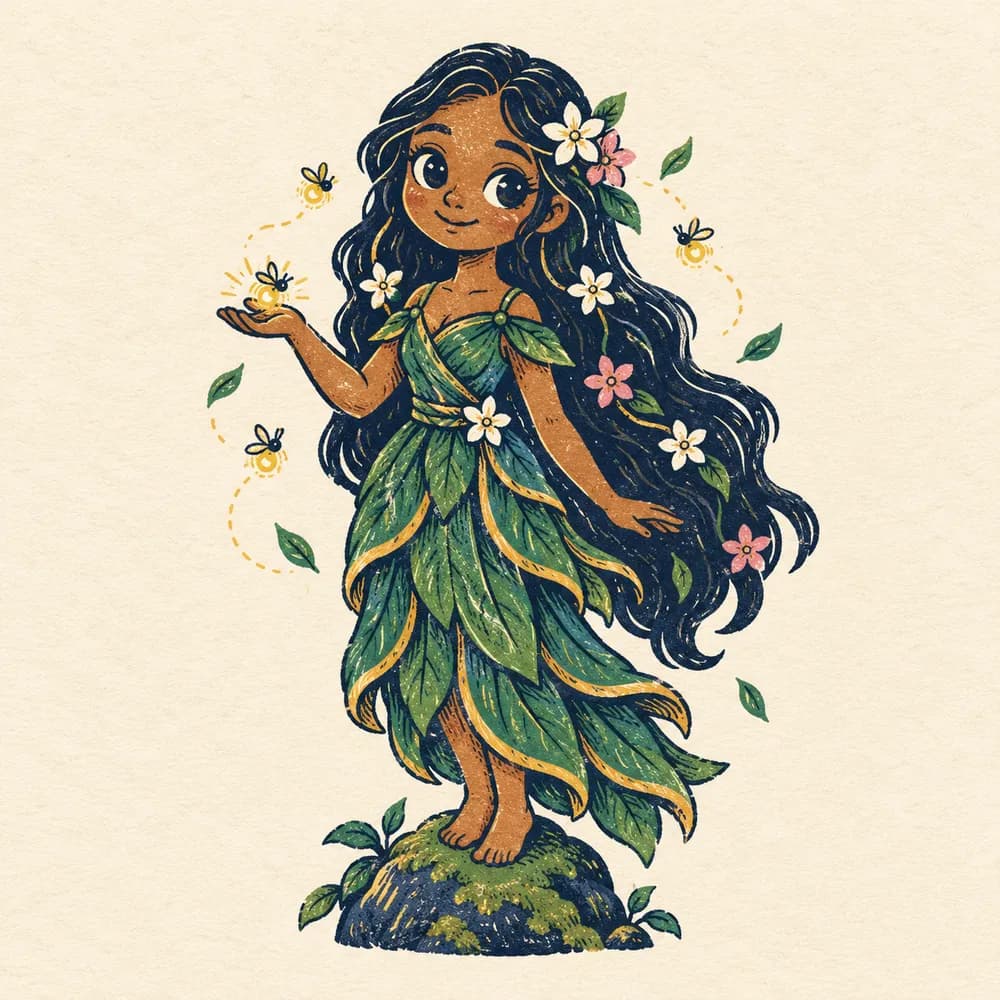
A diwata is a fairy or guardian spirit from Filipino folklore who protects forests, mountains and rivers, like the famous Maria Makiling.
Lola's story
Of all the old stories, this one is my favorite. When I was a girl in Manila, my Lola told me about Maria Makiling, the diwata who lives on Mount Makiling, south of the city. "She has hair so long it touches the ground," my Lola said, "and on misty mornings you can see her walking in the forest, with fireflies in her hair."
"Is she scary?" I asked.
"Only to greedy people," she said. "If you cut down her trees for no reason or catch all her animals, she hides the path, and you walk in circles until you say sorry. But if you are kind, she helps you. Once, they say, she gave a poor farmer a basket of ginger, and when he got home, the ginger had turned to gold."
After that, whenever we went somewhere green, I whispered, "Tabi tabi po," just in case a diwata was listening.
One day I want to take Kuya, Didi and Chun to see Mount Makiling. Didi already wants a dress made of leaves.
What people say
In the old beliefs of the Philippines, before the Spanish came, diwata were gods and spirits of nature who lived in mountains, forests, rivers and the sea. Over time, the word came to mean something like a fairy or a forest nymph: a beautiful, powerful spirit who guards a special place.
The most famous diwata is Maria Makiling of Mount Makiling in Laguna. The writer José Rizal retold her legend in 1890. Other well-known diwata are Mariang Sinukuan of Mount Arayat in Pampanga and Maria Cacao of Mount Lantoy in Cebu. In most stories, a diwata rewards people who are kind and hardworking, and punishes people who are greedy or who harm her forest.
How to stay safe
Be kind to nature. Ask permission before you walk into a forest or pick a flower, by saying tabi tabi po, and take only what you need. A diwata, the stories say, always notices.
Tagalog words and how to say them
| Tagalog | Means |
|---|---|
| bundokboon-DOK | mountain |
| gubatGOO-baht | forest |
| alitaptapah-lee-TAHP-tahp | firefly |
| bulaklakboo-lahk-LAHK | flower |
Questions people ask about the diwata
- What is a diwata?
- A fairy or nature spirit from Filipino folklore who guards a forest, a mountain or a river. In the oldest beliefs, diwata were also gods and spirits of the natural world.
- Who is Maria Makiling?
- The most famous diwata, the guardian of Mount Makiling in Laguna. The stories say she helps kind, hardworking people and protects the mountain's animals and plants.
- How do you pronounce diwata?
- dee-WAH-tah, with the stress on WAH.
- What does a diwata look like?
- Usually a beautiful young woman with very long black hair, dressed in flowers and leaves, who appears and disappears in the forest.
- What does diwata mean in English?
- It is often translated as "fairy" or "nymph", but a diwata is more like a guardian spirit of a place in nature.
- Is the diwata real?
- No. Diwata are part of Filipino folklore and old beliefs, told for generations.
More creatures


Sources
- José Rizal, Mariang Makiling (1890)
- Damiana L. Eugenio, Philippine Folk Literature: The Legends (2001)
- F. Landa Jocano, Philippine Mythology (1969)